

If you haven't check Music Notation Made Simple Part 1 I suggest you check that out before having any plans on reading this section. Of course there is always an exemption, if you happen to already have some knowledge on the basics of music notation, you are more than welcome to read this chapter.
Have Fun!
After years of teaching music, I found a technique of learning how to read music in a simple way. It works for me, it doesn't mean it's the only way. Haha too much ways to say there, I would be more than happy to share how I teach music in my own way!
TECHNIQUES IN READING AND IDENTIFYING LETTERS ON THE STAFF
We have already discussed about the letter names in a previous chapter, so we are now ready to take the next step in using them.
Letter names have equivalent singing names or the solfa syllables which is use more often in singing lessons than on this one. For uniformity purposes we will be using letter names (C D E F G A B) instead of singing names (Do Re Mi...).
READING NOTES ON THE G STAFF
For notes on lines of a treble clef just remember the words Every Good Boy Does Fine. Taking only every first letter of each word would give us the notes on the lines of a G staff.

As for the notes on the spaces of a G staff, we just remember the letters that form the word FACE.

NOTE: THIS METHOD IS ONLY FOR NOTES WITHIN THE STAFF AND NOT BEYOND OR BELOW THE STAFF, WE HAVEN'T TOUCH THE TOPIC ON LEDGER LINES YET
Moving on to the F staff, remember the words, Good Boys Do Fine Always for the notes on the lines of a F staff

and remember ACEG (you can give any meaning for this one) for notes on the spaces of a F staff.

That wasn't so hard I'm sure. The moment you determine a note on the staff, it is then very easy to identify the notes below or above that note. It is one step of identifying the notes on a staff.
Note: The higher the position of a note on a staff, the higher its pitch is. The lower its position on the staff, the lower its pitch is.

Ledger Lines
- are lines located above and below the staff. Its purpose is to guide you when reading notes that are above or below the staff. Without these lines it would be very hard to distinguish notes above or below the staff.
 |
| Notes extending above and below the G staff |
 |
| Notes extending above and below the F staff |
Exercise
Try to answer this exercise to test what you have learned so far. For more exercises, you can go to exercise page of this blog.

The Grand Staff
- when you connect the G staff and the F staff you get what we call the Grand Staff.

In piano music, the treble staff is played by the right hand while the bass staff is played by the left hand
Watch the video of a piano excerpt of Bach's Courante from French Suite No.2
This is an example of a Grand Staff use for Four Part Chorale Writing
In four part chorale writing, the treble staff is use for the Sopranos and the Altos while the bass staff is use for the Tenors and the Basses.
Octave Identification
- the word octave means a series of eight (8) notes, 7 of which are unique and 1 is a repetition of the first
- if you think I lost you there, then this image might help you understand what an octave is

- because the pitch spectrum is so wide, one must be able to identify a specific note by the octave in which it appears.
Now let us view the whole spectrum of pitches in different octaves and identify where our middle C is located.

As you can see base on the figure above, each tone has a certain octave, specific to itself, although you may find C a lot of times, but each C is a different and unique C. That is true to all pitches on the spectrum. This octave identification is approved by the International Acoustical Society. You may want to google the Helmholtz System, this is a derivation of that famous acoustic system.
Accidentals
- are symbols that you place to the left of the note head, that is before the note head, to indicate the raising or lowering of a pitch.
Sharp sign raises the pitch of a note a half step and looks like this

Flat sign lowers the pitch of a note and looks like this

Double sharp sign raises the pitch of a note a whole step and a Double flat lowers the pitch of a note a whole step. Both of these are shown below

This is how you use these accidentals when you write music

Click play to hear the image
Interval
- is the relationship between two tones or the distance between two distinct pitches. In western music, the smallest interval is a half step, in the keyboard, it will be two adjacent keys.

Listen how these half steps sound like
Enharmonic Equivalents
- are tones that have the same pitch but spelled differently or have different letter names


Half step motion
- in music passages involving a half step motion, often a flatted note is followed by a note that is spelled differently and is a half step lower.

a sharp note is usually followed most often with a note a half step higher and spelled differently.

That ends our part 2 of this chapter, please proceed to part 3

As we begin our journey into the vast world of sounds and beauty I pray that you would continue to grow and find interest in this path you are undertaking.
Notation of Pitch
Staff
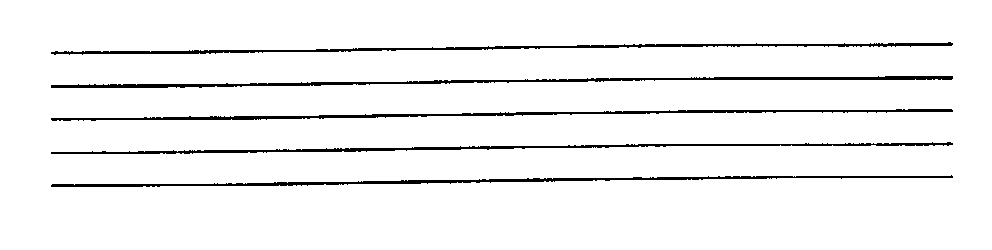
- it is consist of five equally spaced horizontal lines which makes four spaces in between them.
Bar Lines
- are lines that divides the staff into measures

Few other types of bar lines
Double bar line
- indicates the end of a section; in simply means you are at the end of a certain part of a song or music
Fine or End
- indicates the end a piece or a musical score.

Repeat signs
- there are many types and symbols of repeat signs but let us discuss the commonly used ones.

The forward repeat sign tells us to play the section of a piece until we see the nearest backward repeat sign which also indicates to go back to the nearest forward repeat sign.
Letter Names
- the various pitches in our musical language are referred to by the first seven letters of the alphabet.
A B C D E F G
- here is how you locate them on the keyboard


The CLEFS
- it is a symbol placed before a line of music that will establish the letter names on the lines spaces of a staff
- it is a french word which means "KEY" in english
Types of clefs
G clef or Treble clef
 |
| don't worry about the color, I just think it's kinda cool to look at |
- the G clef or the treble clef is an ornate letter G. Simply put, it's a letter G that evolved into that symbol
- this is how we draw a G clef

- when you place a G clef on the staff, you call that staff now a "G staff"

- notice the clef curling around the second line? The G clef designates that G is located at the second line
- so now that we know that G is on the second line by reason of the G clef, we can then identify the notes on the other lines and spaces on the staff using G on the second line as our reference point. (Please, oh please, this is just a hint, do not use this as a method for sight reading)The G clef is used
The F clef or the Bass clef
- the bass clef is also called the f clef because it was derived from the letter F. Like the g clef, it designates where to look for the letter F on the staff.

- the note F is located between the dots of the F clef, that is the fourth line of the staff
- this is how we draw a bass clef

-when you place a bass clef or an f clef on the staff, you call that staff a "F staff"

The C clef or the Movable Clef
- so many are confused and bedazzled by this strange clef, the c clef. Especially those who haven't had any formal music training at all. DO NOT BE AFRAID!
- the c clef works this way. Wherever the pointy arrow part of the clef points at, that is where you will find you middle C if you are using this clef.
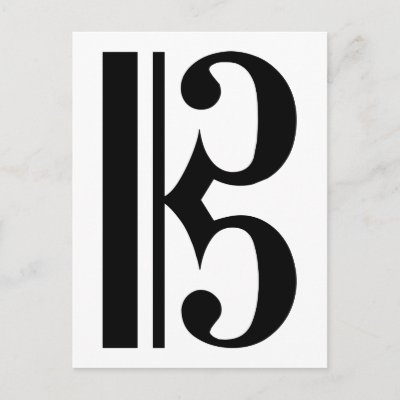
- the reason why this is called a movable clef is because it really is movable (wow that was deep, LOL)
- to illustrate that further, take a look at the image below

- The tenor clef has its middle C located on the fourth line
- The alto clef has its middle C located on the third line
- The mezzo soprano clef has its middle C on the second line
- The soprano clef has its middle C on the first line.
Here is another image on how these different clefs are use

Rhythm Clef or the Neutral clef or Percussion Clef
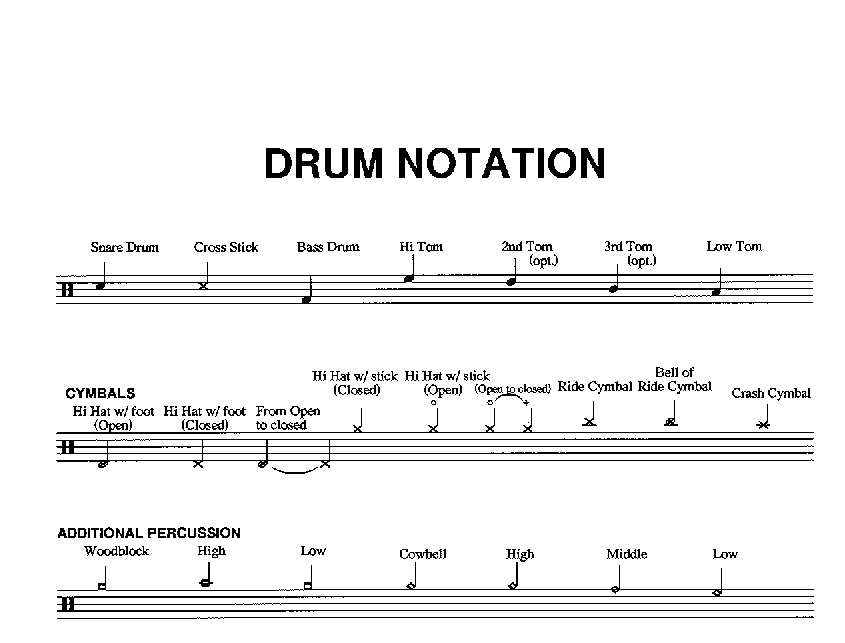
- this is a clef that is use for non pitched instruments, like the drums, percussion section, and others alike
- this clef shows mainly the rhythm of the music being played

Here is an example of how a rhythm clef is use and how it is use on drum notation
If you have finished reading this chapter of music theory, please continue reading MUSIC NOTATION MADE SIMPLE PART 2

The basic materials of music is SOUND and TIME, so we really need to understand first and define these terms to make sure we are on the same page. Simply put, I don't want my readers confused with terminologies being posted in this blog.
Sound is the sensation we sense by our hearing (the ear) when sound waves are produce and reaches the ear. Vibration is the periodic motion of a substance. Example, just pluck the strings of a guitar. You would normally see the strings moving back and forth making vibrations together with the air and the whole guitar itself. Thus, you hear sound because of vibrations.
THE FOUR PROPERTIES OF SOUND
Pitch
-is the highness and lowness of a sound. The greater the vibration of a sound, the higher the pitch we hear.
Tone
- is a musical sound of definite pitch.
Intensity
- is heard as the loudness or softness of a pitch, also termed as amplitude.
- in music, intensity is interpreted by the following Italian terms.

Duration
- is the the length of time, a pitch or a tone is sounded. There are different patterns of tone but the terms used on this subject are meter and rhythm. We will discuss these terms in a different topic, let us leave it as it is for now.
Timbre
Timbre
- is the quality of a sound being produce, you may also call it the tonal color of a sound. It is the very property of a sound to let us distinguish the difference of two sound sources. That is why we can identify the sound of your mother yelling at you from the sound of a doorbell.
There you go! I think you are ready to start the lessons now. I have reserved the other terms on different topics and did not include them here for the reason that they might try to scare away a few interested musicians. We will try to keep a friendly learning environment within this blog. Not that those terms aren't friendly at all but I would like to somehow simplify even the most complex matters under this study.


